
Facial reconstruction after skin cancer
Restoring form and function after skin cancer removal
Mohs reconstruction addresses skin cancer defects following Mohs surgery, restoring facial contour, symmetry, and function — including nasal, eyelid, and lip defects. Often, local flaps or grafts are used depending on defect size and location.
Facial reconstruction at a glance
Overview
Facial reconstructive surgery after skin cancer restores function and appearance following removal of basal cell carcinoma, squamous cell carcinoma, or melanoma lesions. Dr. Anghel collaborates with Mohs surgery dermatologists and surgical oncologists for seamless, coordinated care. Mohs micrographic surgery is the gold standard for facial skin cancer removal, preserving healthy tissue while ensuring clear margins.
Once margins are confirmed, Dr. Anghel reconstructs the defect with precision to restore facial contours. Her facial reconstructive surgery training make her exceptionally equipped to navigate complex defects across the nose, eyelids, lips, ears, cheeks, and forehead.
Recovery
Facial reconstruction recovery varies by defect size, location, and complexity. Most smaller reconstructions allow return to social activity within 7–14 days, while larger cases involving flap reconstruction or skin grafting may require 2–4 weeks. Swelling, bruising, and tightness resolve progressively over subsequent weeks. Most patients manage discomfort comfortably with over-the-counter medications.
Dr. Anghel provides detailed wound care instructions, recommending sun avoidance on healing incisions and limited strenuous activity or pressure on the reconstructed area, while closely monitoring healing throughout skin cancer reconstruction recovery.
Results
Facial skin cancer reconstruction aims for undetectable results, with incisions placed within natural creases, aesthetic unit boundaries, and shadow lines whenever possible. Scars begin as fine pink lines, maturing to thin, pale lines over 12 months.
For patients needing scar revision after initial reconstruction, additional refinement procedures are available, with ablative laser resurfacing frequently used during final scar maturation to blend texture and tone. Full healing completes in one year, though many patients notice meaningful improvement well before this milestone.

Types of facial reconstruction

For smaller defects with sufficient surrounding tissue laxity, primary closure brings the wound edges together directly in a carefully planned orientation — aligning the closure with natural relaxed skin tension lines to minimize tension and produce the finest possible scar. This is the simplest and most elegant solution when anatomy allows.
Primary closure

For larger or more complex defects, local tissue flap reconstruction borrows adjacent skin and soft tissue — preserving its blood supply — and repositions it to fill the defect. Dr. Anghel is highly skilled in a range of facial flap techniques, including advancement flaps, rotation flaps, and transposition flaps, selecting the approach that best respects the aesthetic unit involved and minimizes visible scarring.
Local flap reconstruction

When local tissue is insufficient or a flap is not appropriate, full-thickness skin grafting uses donor skin harvested from a concealed site — most commonly the upper forehead or at the clavicle — to resurface the defect. Dr. Anghel selects donor sites that closely match the color, texture, and thickness of the recipient area to achieve the most natural possible result.
Full-thickness skin grafting
The nose is the most structurally and aesthetically complex region of the face, and nasal reconstruction after skin cancer demands exceptional surgical skill. Depending on the size and depth of the defect, reconstruction may involve cartilage grafting, forehead flap reconstruction, or a staged approach over multiple procedures to rebuild the nose's structural framework and surface skin. Dr. Anghel's background in rhinoplasty and many years of working as a student with Dr. Frederick Menick uniquely informs her approach to nasal defect reconstruction.
Nasal reconstruction
Eyelid reconstruction after Mohs surgery requires both cosmetic precision and functional expertise — the eyelids must open and close properly, protect the eye, and distribute the tear film. Dr. Anghel's training in blepharoplasty and eyelid surgery makes her highly qualified to address defects of the upper and lower eyelids, restoring both appearance and the critical protective function of the lid.
Eyelid reconstruction
The lips are among the most functionally and aesthetically sensitive areas of the face. Lip reconstruction after skin cancer excision addresses defects of the upper lip, lower lip, and vermillion border — restoring natural lip shape, movement, and proportion. Techniques range from primary closure of lip defects to Abbe flap and Karapandzic flap reconstruction for larger resections.
Lip reconstruction
For patients who have previously undergone skin cancer reconstruction — whether with Dr. Anghel or another provider — and wish to improve the appearance of a healed scar, scar revision surgery combined with ablative CO2 laser resurfacing can significantly refine the result. This may include excision and re-closure, dermabrasion, or laser treatment depending on the scar's characteristics
Scar revision and refinement
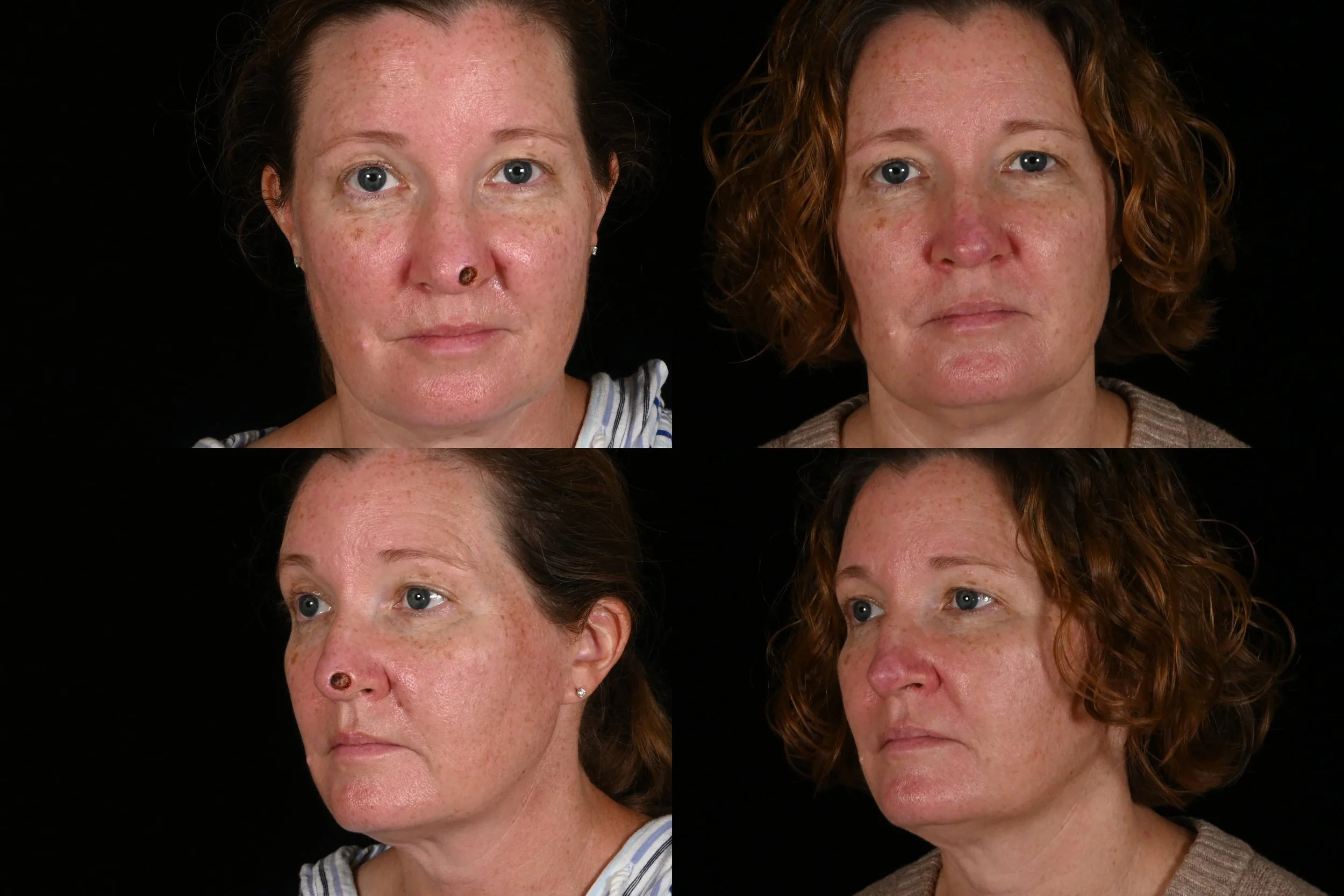
Comparison of two women before and after facial treatment, showing reduced freckles and blemishes, with different hairstyles.
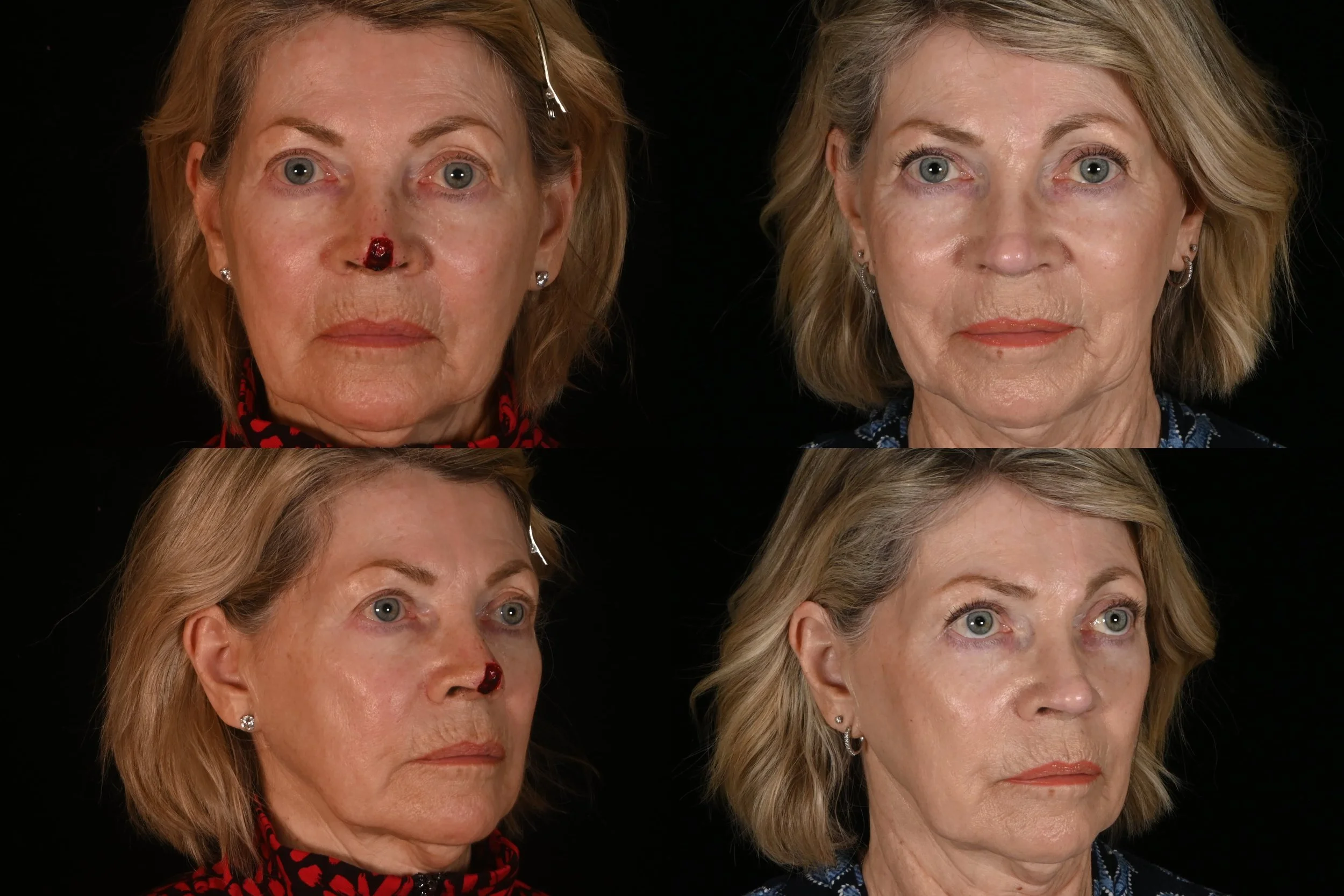
Side-by-side comparison of a middle-aged woman's face before and after cosmetic treatment, showing improved skin appearance and reduced signs of aging.
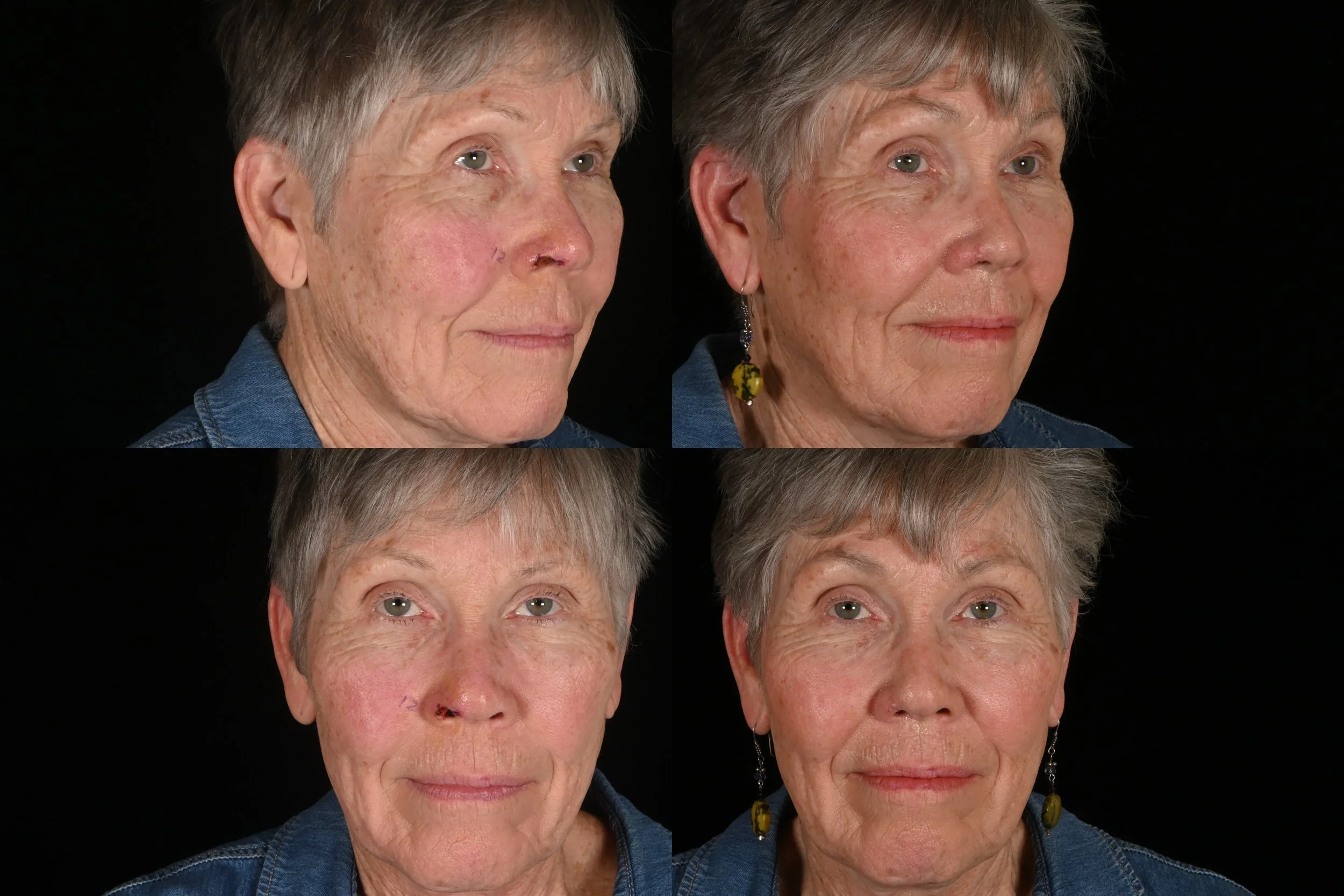
Four images of an elderly woman showing a progression of facial changes or medical treatment, with the first image showing her with some skin lesions and the last showing clear skin.
“I was really nervous to have work on the tip of my nose due to skin cancer but it was wonderfully done! I highly recommend Dr. Anghel for not only her successful surgery but for her honesty and kindness! Thank you Dr. Anghel”
“Dr. Ersilia Anghel Repaired my nose after skin cancer surgery. It looks better than ever. She communicated clearly from what was going to take place to how I was going to recover. I am so happy with the way my nose turned out.”
“When I was diagnosed with squamous cell carcinoma on my upper lip I was terrified. What would I look like after surgery? I had a pre-op appointment with Dr Anghel and she showed my pictured and explained the process. After my MOHS procedure I was closed up by Dr Anghel and today there is absolutely no sign that I had the procedure. Absolutely the BEST!!!”
“Dr. Anghel is amazing! I had skin cancer on my face that would have left a bad scar but I had her stitch it up and you can’t see where it was. I would recommend her to any of my family and friends.”
-
Avoid blood thinning medications and nicotine. Discuss your surgery with your support person so they are ready to help the first 24-48 hours after surgery. We can arrange for hired help, if requested.
-
You can combine eyelid surgery, fat grafting, lip lift, ablative laser skin resurfacing.
-
Patients report that they feel well informed and cared for from the consultation through their recovery. They feel like ample time is given to answer all their questions. Read more about patients’ experiences here.
-
Healthy patients who desire an improvement in their face and neck are good candidates for deep plane face and neck lift. Patients can have unfavorable anatomy and desire an improvement earlier in life in their 30s or more commonly in their 50s. Patients should be within 15 pounds of their ideal goal weight prior to surgery.
Patients are required to be nicotine free 4 weeks before and 4 weeks after surgery.
-
Bleeding, infection, delayed healing, scarring, nerve dysfunction, cosmetic dissatisfaction, and anesthesia complications.
-
For isolated necklift surgery: underneath the chin and in some cases around the ear lobe.
For face and neck lift surgery: underneath the chin and around the ears into the occipital hairline.